Today is 10.24 Programmer's Day, and I happened to see a very interesting image:
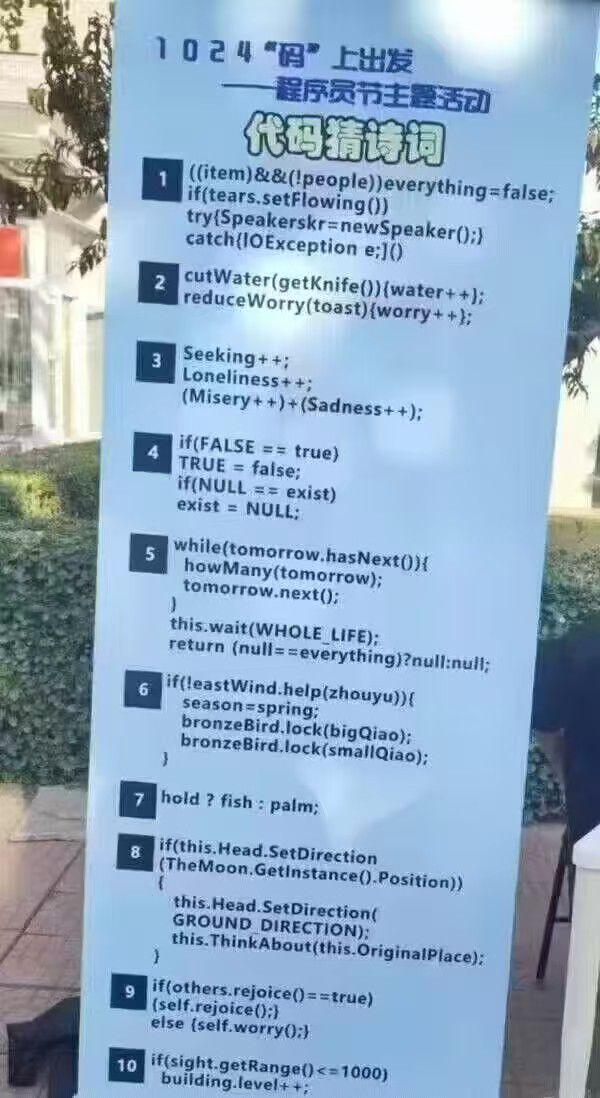
The image showcases an activity called "Code Poetry Guessing," which uses programmers' code logic to metaphorically represent ancient poetry. I found it very interesting, so I tried to solve some of the problems:
1.#
((item) && (!people))everything = false; if(tears.setFlowing()) try{Speakerskr=newSpeaker();} catch(IOException e){}
Answer: Things are present, but people are not; when I want to speak, tears flow first.
Explanation: The code item && !people means "things are present, but people are not," corresponding to "物是人非"; while tears.setFlowing() expresses the scene of "tears flowing first."
Source: Li Qingzhao, "Wuling Spring • Late Spring"
2.#
cutWater(getKnife())(water++); reduceWorry(toast)(worry++);
Answer: Drawing a knife to cut water makes the water flow even more; raising a cup to dispel sorrow only increases sorrow.
Explanation: cutWater means "drawing a knife to cut water," while water++ represents that the water continues to flow; reduceWorry intends to "dispel sorrow," but worry++ indicates that worries still increase.
Source: Li Bai, "Farewell to Xie Tiao at the Xuanzhou Tower"
3.#
Seeking++;
Loneliness++;
(Misery++) + (Sadness++);
Answer: Searching and seeking, cold and desolate, miserable and sorrowful.
Explanation: This code increases "Seeking," "Loneliness," "Misery," and "Sadness," conveying desolation and solitude.
Source: Li Qingzhao, "Voice Slow • Searching and Seeking"
4.#
if(FALSE == true) TRUE = false;
if(NULL == exist) exist = NULL;
Answer: When false is taken as true, true also becomes false; where there seems to be something, there is actually nothing.
Explanation: This code explores the concepts of truth and falsehood (FALSE == true) and existence (NULL == exist). When "false" is considered true, then true becomes false; and in places that seem to have something, there is actually nothing.
Source: Cao Xueqin, "Dream of the Red Chamber"
5.#
while(tomorrow.hasNext()){
    howMany(tomorrow);
    tomorrow.next();
}
this.wait(WHOLE_LIFE);
return (null == everything)? null: null;
Answer: Tomorrow after tomorrow, how many tomorrows there are; I wait for tomorrow, and everything becomes a delay.
Explanation: This code represents the endless waiting of "tomorrow" through an infinite loop. The program waits for an entire lifetime (this.wait(WHOLE_LIFE)), ultimately returning a meaningless result (return null), expressing the idea that waiting for tomorrow will only lead to missed opportunities.
Source: Qian Fu, "Tomorrow Song"
6.#
if(leastWind.help(zhouyu)){
    season=spring;
    bronzeBird.lock(bigQiao);
    bronzeBird.lock(smallQiao);
}
Answer: If the east wind does not assist Zhou Lang, the bronze sparrow locks the two Qiaos in spring.
Explanation: This code expresses the scene where the east wind aids Zhou Yu, and the two Qiaos are locked in the bronze sparrow platform. leastWind.help(zhouyu) symbolizes the east wind helping Zhou Yu, while bronzeBird.lock(bigQiao) and bronzeBird.lock(smallQiao) refer to "Big Qiao" and "Small Qiao" being locked in the bronze sparrow platform.
Source: Du Mu, "Red Cliff"
7.#
hold ? fish : palm;
Answer: One cannot have both fish and bear's paw.
Explanation: In this ternary expression, hold ? fish : palm represents the choice of one of the two; choosing fish means one cannot have bear's paw, and vice versa.
Source: Mencius, "Mencius • Gaozi I • What I Desire"
8.#
if(this.Head.SetDirection(TheMoon.GetInstance().Position)){
    this.Head.SetDirection(GROUND_DIRECTION);
    this.ThinkAbout(this.OriginalPlace);
}
Answer: Looking up at the bright moon, lowering my head to think of my hometown.
Explanation: This code describes the process of turning the head towards the moon (this.Head.SetDirection(TheMoon.GetInstance().Position)), then turning the head towards the ground (this.Head.SetDirection(GROUND_DIRECTION)), and thinking about the original place (this.ThinkAbout(this.OriginalPlace)). This process symbolizes the scene in the poem: first looking up at the bright moon, then lowering the head to miss the hometown.
Source: Li Bai, "Quiet Night Thoughts"
9.#
if(others.rejoice()==true) (self.rejoice());
else (self.worry());
Answer: Rejoicing in others' joy, one also rejoices in their joy; worrying in others' sorrow, one also worries in their sorrow.
Explanation: The code indicates that when others are happy, one feels happy too (self.rejoice()), and when others are sad, one feels worried (self.worry()). This aligns closely with the meaning of "Rejoicing in others' joy, one also rejoices in their joy; worrying in others' sorrow, one also worries in their sorrow," reflecting the idea of caring for others and empathizing with them.
Source: Mencius, "Mencius • Liang Hui Wang II"
10.#
if(sight.getRange()<=1000) building.level++;
Answer: To see a thousand miles, one must climb another floor.
Explanation: When the sight range is less than or equal to 1000, the building's level increases, meaning that to see further, one needs to climb higher. This resonates with "climbing another floor," expressing the idea of expanding one's vision through continuous self-improvement.
Source: Wang Zhihuan, "Climbing the Stork Tower"
If there are any errors, please feel free to correct them!
This article is synchronized and updated by Mix Space to xLog. The original link is https://blog.qwq.my/posts/life/not-the-normal-decoding